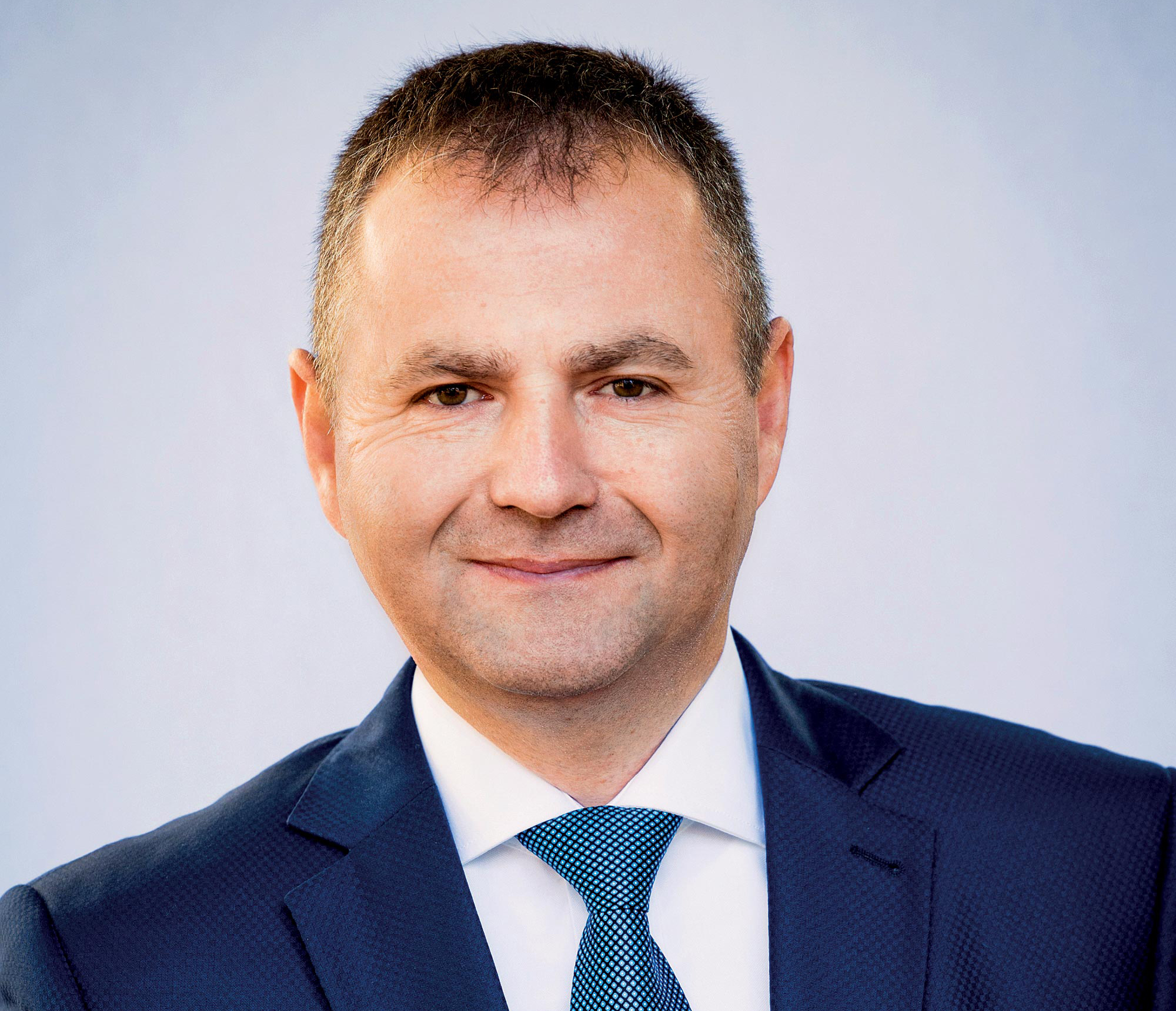
Our chat with Member of the Slovak National Council Marián Kéry (SMER-SD) revolved primarily around international topics. It makes sense, seeing as Marián Kéry is the chairman of the Foreign Affairs Committee of the Slovak NC and a member of the Committee on European Affairs.
You deal intimately with your country's foreign policy as the chairman of the Foreign Affairs Committee of the Slovak NC. How should we interpret the term "sovereign foreign policy of the SR", which is often used by PM Robert Fico and others?
It's quite simple. The sovereign foreign policy of the Slovak Republic is the kind that respects our ties to the European Union and NATO, which doesn't mean, however, that we should keep silent if the measures implemented by these two organizations go against our national interests. At the same time, sovereign foreign policy understands that powers (Russian Federation, China) whom the Slovak Republic wants to and needs to have good political and subsequent economic relations with stand outside the aforementioned structures. In other words, a small country such as ours is literally obligated to foster good relations with everyone who merits such an approach and who is also interested in fostering good, mutually beneficial relations with us.
The meeting between Minister of Foreign Affairs Juraj Blanár and his Russian counterpart Sergey Lavrov caused quite a stir at a time when the EU is attempting to isolate and sanction Russia for its invasion of Ukraine...
How was this meeting any different from the meeting between Sergey Lavrov and the US Secretary of State Antony Blinken? I must have missed all the criticism that was piled on the US State Secretary. Diplomacy is the basis of conflict resolution and often helps prevent it altogether. Yes, we are a small country in terms of population and land mass. But why should we give up on
our possible contribution to diplomacy and peace? Dripping water erodes stone not by force, but by perseverance. Small countries which could be considered the metaphorical drops of water are capable of much more than they think.
Is it still official going forward that Slovakia will provide humanitarian but not military aid to Ukraine?
Yes, Slovakia will no longer be sending arms to Ukraine from its national supplies. Nor can it. Our stores are empty; previous governments have sent nearly everything to Ukraine. Slovakia, if I were to take it to the extreme, would be hard-pressed to find the tools to defend itself right now. All we can do is rely on our allies if things go awry and gradually do what is within our means to equip our army once more. That's why I'm very happy that the first F-16 fighter jets are set to arrive in Slovakia in the middle of this year. The former governments also deserve criticism for sending our S-300 air defense systems to Ukraine. As for humanitarian aid, it will continue as planned.

With Member of the Slovak NC Tibor Gašpar.
Different views on the conflict in Ukraine have divided the Visegrád Four. Does the Group still have a future even so?
I firmly believe that the V4 has a bright future. If only because all of our countries together form a community of 65 million people. And that's a power that even the Germans and the French have to pay heed to whether they want to or not. Our views within the Group don't align on every issue, of course. But that's completely legitimate. We should be careful not to criticize one another for our views, or worse yet lecture one another, and in the worst case stop meeting altogether. Allow me to illustrate with a specific example from the past. Do you recall how the V4 managed to stick together and exert pressure that played a decisive part in mandatory quotas not being implemented a few years ago? I still consider that to be a major victory for our Central European countries. I might also mention the topic of dual food quality. You are correct in the sense that Slovakia and Hungary have different views on sending arms to Ukraine than Poland and the Czech Republic do, and we also don't believe in resolving the military conflict in a militaristic manner.
Czech media was full of the news that Robert Fico's government wants to make state administration leaner by nearly thirty percent. Is it realistic?
Those are just initial thoughts and considerations at the moment. Seeing as the governments of Matovič, Heger, and Ódor have left our national finances in ruin, the current government is forced to consolidate. And that's why it's looking for ways to avoid these unpopular measures being detrimental to our people's standard of living. To make sure the measures don't turn antisocial, to do things in a sustainable way. The mission to fix government spending is not exclusive to Slovakia, but it's in the cards for nearly every EU country. Robert Fico's government intends to be, and I believe will be, a reasonable steward of our finances.
I would also like to hear your opinion on the European resolution from January, which was a reaction of MEPs to certain changes in Slovak legislation. Could you comment on it shortly?
Abolishing the Special Prosecutor's Office was a political decision. The Office was spawned by politics and terminated by politics. The SPO was headed by Daniel Lipšic, a former politician (multiple minister) who hated us – his political opponents – with a passion and acted that way. Did you know that before Lipšic was elected to head the Office by the MPs of the National Council from the ranks of the former ruling coalition, he was officially sentenced for manslaughter, having run somebody over at a traffic crossing? The changes to the Criminal Code were meant to align our sentencing more closely with countries such as Czechia, Austria, and Germany. We were even planning to initiate the switch from retributive to restorative justice. The opposition politicized this extremely technical topic and organized protests. As for the resolution of the European Parliament, its authors were probably thinking the more, the merrier when they wrote it. The biggest culprits are Slovak MEPs representing opposition parties in Slovakia. Their inability to make peace with the results of a democratic election for the Slovak NC and the presidential election is shameful. They're trying to harm Slovakia in the eyes of prominent European institutions; many of them are doing their utmost to stop the flow of European funding to the Slovak Republic. I see these actions as absolutely unacceptable.

With wife Adriana and daughters Adriana and Agáta.
How do you feel about the course and result of the presidential election? Could the HLAS-SD and SMER- SD parties merge as per the rumors going around?
I am pleased with the result of the presidential election as is my party SMER-SD. After ten years, the Slovak Republic has found a president who has the potential to bring peace, a president with experience in politics, a mature statesman who will defend our interests abroad, and who will always put both the Slovak people at home and our national interests first. As for the potential impact the result of the presidential election could have on the Slovak political landscape, it's too early to speculate. I reject the notion that the HLAS-SD party could merge with my own political party in the near future
CV BOX
Marián Kéry (born February 6, 1978, in Zlaté Moravce) is an MP in the Slovak National Council.
He graduated from the Faculty of Philosophy at Constantine the Philosopher University in Nitra, specializing in history and the Russian language. He is currently studying law at Matej Bel University in Banská Bystrica.
He started out as a teacher at the Janko Kráľ Grammar School in Zlaté Moravice, later going on to teach at a primary school in Červený Hrádek, where he became the municipal representative at nineteen.
In 2001, he joined SMER-SD and became chairman of the local branch in Zlaté Moravce the same year. Last year, he was elected chairman of the party's regional branch. He has been a representative of the Nitra Self-Governing Region since 2005 and a member of the National Council since 2012, where he primarily deals with foreign policy matters. He has been the chairman of the Foreign Affairs Committee since 2020.
Kéry is married, he and his wife Adriana have two daughters – Adriana and Agáta. He enjoys sports, specifically football and tennis. He used to play football himself, becoming a football referee at 18. He worked in the major leagues of the Slovak Football Association for six years as an assistant referee.
ad

ad



