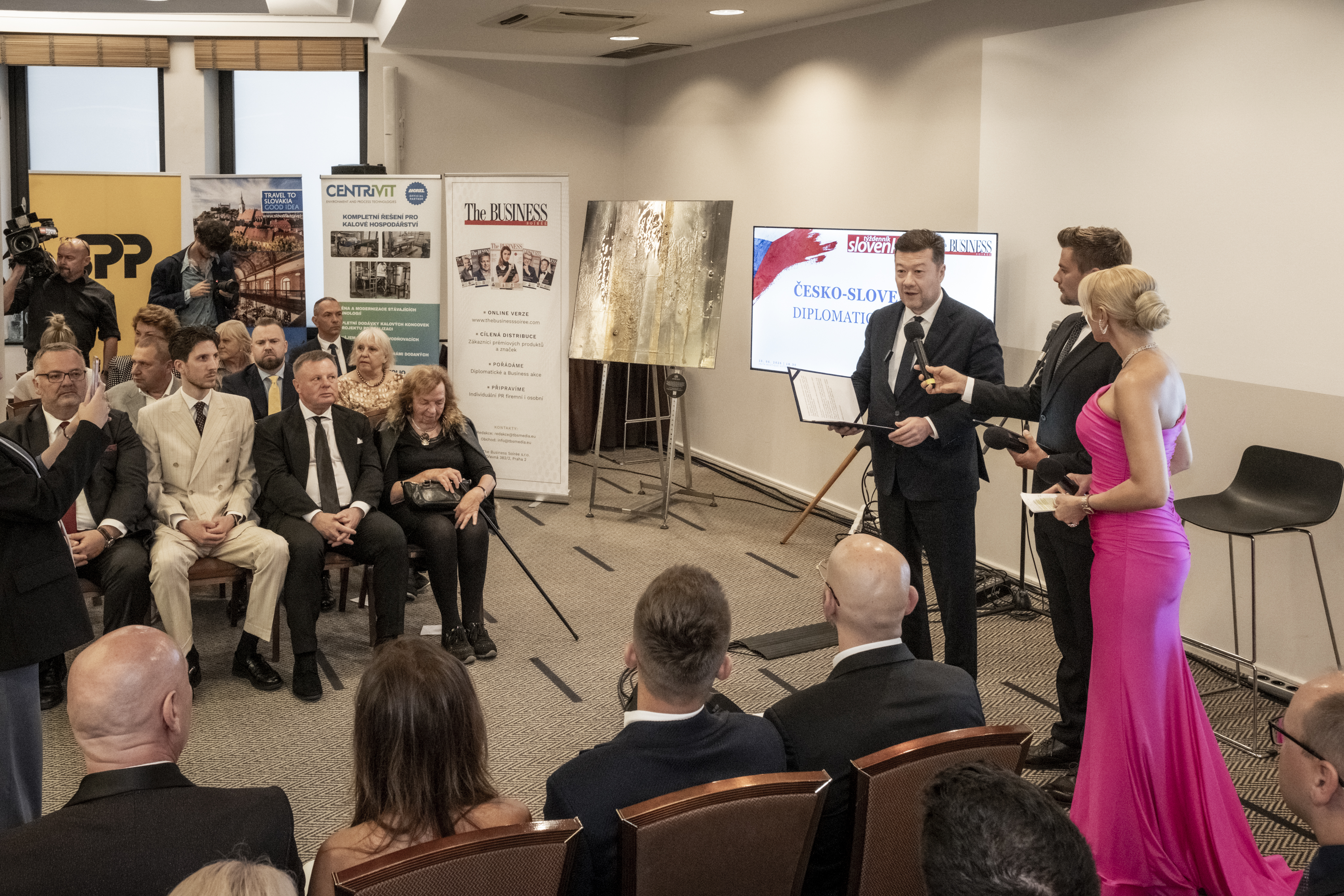
After four years as an opposition MP, Karel Havlíček returned following last year’s elections to the post of minister of industry and trade. At the same time, he serves as Deputy Prime Minister and remains the second most senior figure in the ANO 2011 movement. He took over the ministry in a challenging situation – the end of coal, high energy prices, labor shortages, and uncertain global alignments.
Last year, the Czech Republic recorded one of the fastest economic growth rates in Europe. Is there something to celebrate, and can the pace be maintained?
It is good that the economy is growing, but I am not planning any grand celebrations. Part of that growth reflects a rebound from the bottom. If it is to continue in 2026, it must be supported by concrete government steps – and we are already taking them. Immediately after the new government took office, we reduced electricity prices for households and businesses, because no economy can function without affordable energy. We submitted a new Building Act for approval to finally speed up construction – unlike the previous Pirate experiment, which only brought everything to a halt. At the same time, we are systematically reducing the number of civil servants and cutting unnecessary bureaucracy, because today the state hinders business more than it supports it. If we want to maintain growth, we must create normal conditions for companies: cheaper energy, faster permitting, less paperwork, and stronger investment support. If we deliver on this, we have a chance to keep growing. If not, growth will quickly move beyond our borders.
At the ANO congress, you received more votes than Andrej Babiš. Why did you not run for chairman?
Because politics is not a contest of egos. The ANO movement functions as a team, and everyone has their role. Andrej Babiš is the undisputed leader of the movement and has a strong mandate from the delegates. I focus on economic issues – industry, energy, investment. What matters to me is that the movement functions well and delivers results.
You are taking over energy policy at a time when coal is ending, and new nuclear units are still pending. What must Czechia do?
We need to be honest – there is no simple solution. Coal is ending and new nuclear blocks are not yet in place. That means that in the transitional period, we need stable sources – typically gas – but with a clear plan so that it does not become a long-term dependency. Nuclear power must remain the backbone of Czech energy. One project will not suffice; we must prepare further steps and also look at small modular reactors. At the same time, we need massive investment in grids, because without them, no transformation will work. And then there are energy prices. If we burden Czech industry more than neighbouring countries do, we will simply drive it abroad. That is why I have long argued that in Europe we must push for limiting ETS1 allowance prices and rejecting ETS2.

Does industry still make sense, or should we shift more toward services?
Czechia is an industrial country, and industry will remain the backbone of the economy. Without it, there will be no well-paid services. But industry must evolve – toward higher added value, automation, research, development. It is not a choice between industry and services. The right path is industry – and the services around it: IT, development, logistics, design, maintenance. Above all, we must create conditions that encourage companies to invest here, not two borders away.
Is the inflow of foreigners, including Ukrainians, helping the Czech economy?
From a purely economic perspective, Czechia has long faced a labor shortage, and we cannot manage without controlled migration. Ukrainians today work in large numbers and help keep parts of the labour market and service sector afloat. At the same time, this places demands on the state – schools, housing, administration. The key is to have fast but controlled rules and to strictly combat abuse of the system.
How important is a free trade agreement between the EU and India?
It is highly significant, even if its effects will not be immediate. India is a vast market, and at a time when the world is moving toward protectionism, every opening of trade is crucial. For Czechia, it is essential that not only the largest states benefit, but also our companies – in engineering, energy technologies, automotive and ICT. We must be proactive and help Czech exporters enter that market.
Is Ukraine’s reconstruction an opportunity for the Czech economy?
Yes. And I say this pragmatically: it is morally right and economically rational at the same time. Ukraine’s reconstruction will be a project for many years – infrastructure, energy, healthcare, industry. Czech companies have much to offer. The state must help them with financing, risk insurance, and on-the-ground presence. If Ukraine gets back on its feet, it will mean a more stable Europe and new contracts for our companies. The two go hand in hand.
The author is a European editor of Deník
CV BOX
Karel Havlíček (born August 16, 1969, in České Budějovice) is an MP, deputy speaker of the Chamber, and first vice-chair of the ANO movement.
He graduated in building engineering from the Faculty of Civil Engineering at CTU Prague, earning a Master of Engineering degree. In 1998, he earned his MBA from the PIBS accredited by Manchester Metropolitan University. He finished his PhD in economy and management in 2004 at the Faculty of Business Administration at PUEB, where he also became an associate professor at the Faculty of Finance in 2014.
In 2019, he was appointed minister of industry and trade while also becoming the economic secretary and a year later, the minister of transportation.
He had only joined the ANO movement as a member in 2021; he was elected the first vice-chair in February 2023 while also becoming the prime minister of the shadow cabinet. He was further elected deputy speaker of the Chamber the same month.
Havlíček is married, he has two children. He speaks English, German, and Russian, and partially Spanish, French, and Chinese. He is an avid fan of rock and folk music.
reklama