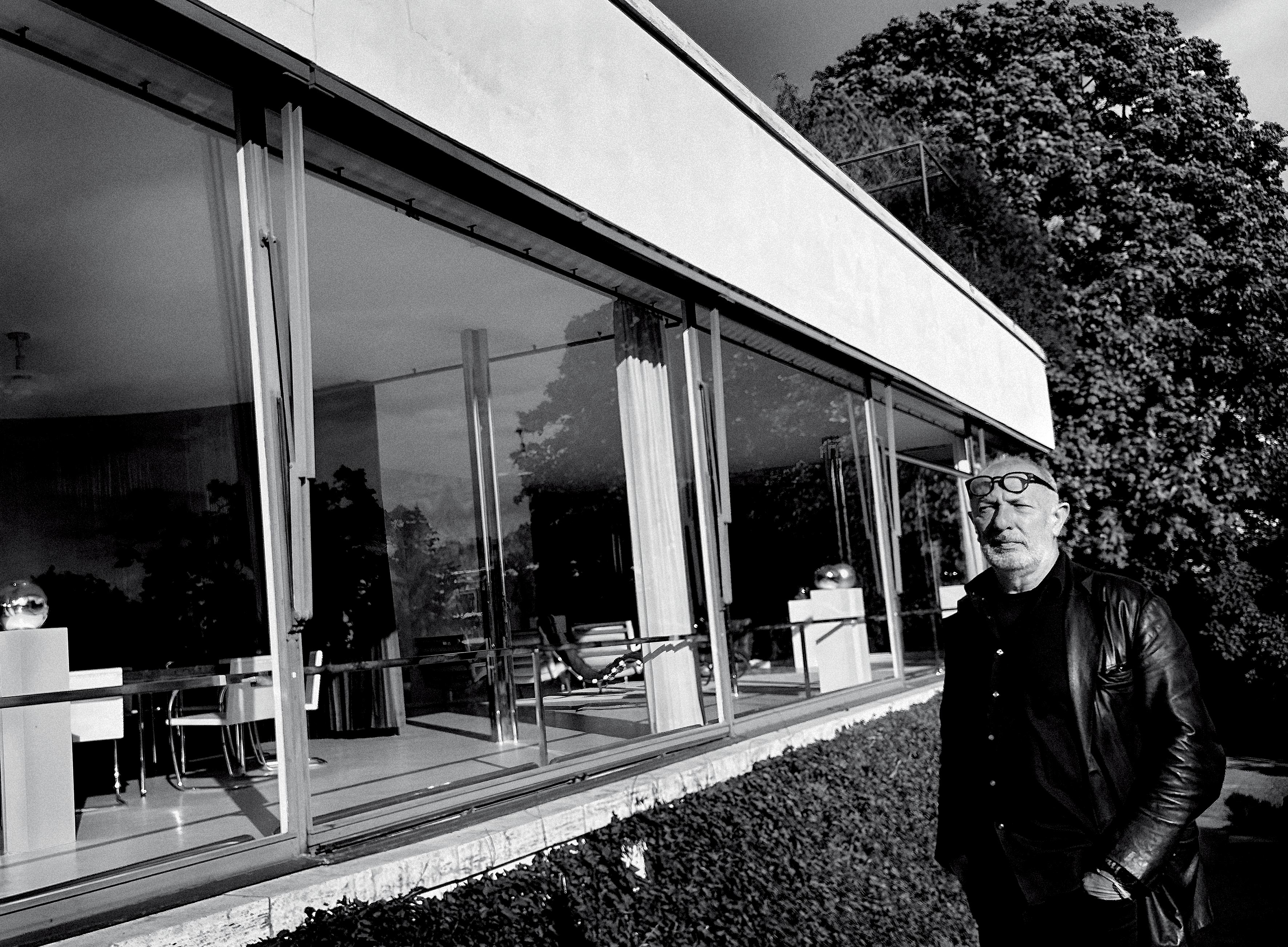
Successful architect Radan Hubička inherited his profession from his father, who was similarly successful, and has been handing it down to his progeny. The V Tower skyscraper in Prague's Pankrác district has undoubtedly become his most famous piece of work, but he's done plenty of other wonderful projects. Among them the refurbishment of the Hybernská 1 building in Prague, which received the Building of the Year 2021 award and also won the BIG SEE Awards 2022 in the public architecture category.
Is it more difficult to refurbish a historical building or to build on a greenfield site?
That's an entirely different ball game. When refurbishing, you're working with the original building, you need to maintain a certain context. In terms of Hybernská, it was also a cultural landmark, so the criteria were much more strict. It is a former baroque palace, refurbished during the classicist period – and then you have the investor commissioning an office building. You need to fit a fire escape, air conditioning, cooling, new wiring, an elevator, etc. If you're not sensible about it, you might demolish the baroque ceilings and end up making some really brutal changes. We agreed with the heritage conservation people that it will be a new construction that accentuates all of the current elements and that we'll refurbish the original building with reverence. What ensued was a wonderful dialog between the past and the present, and it all came out perfectly, also thanks to the positive attitude of the heritage conservation people.
Were you forced to use specific materials?
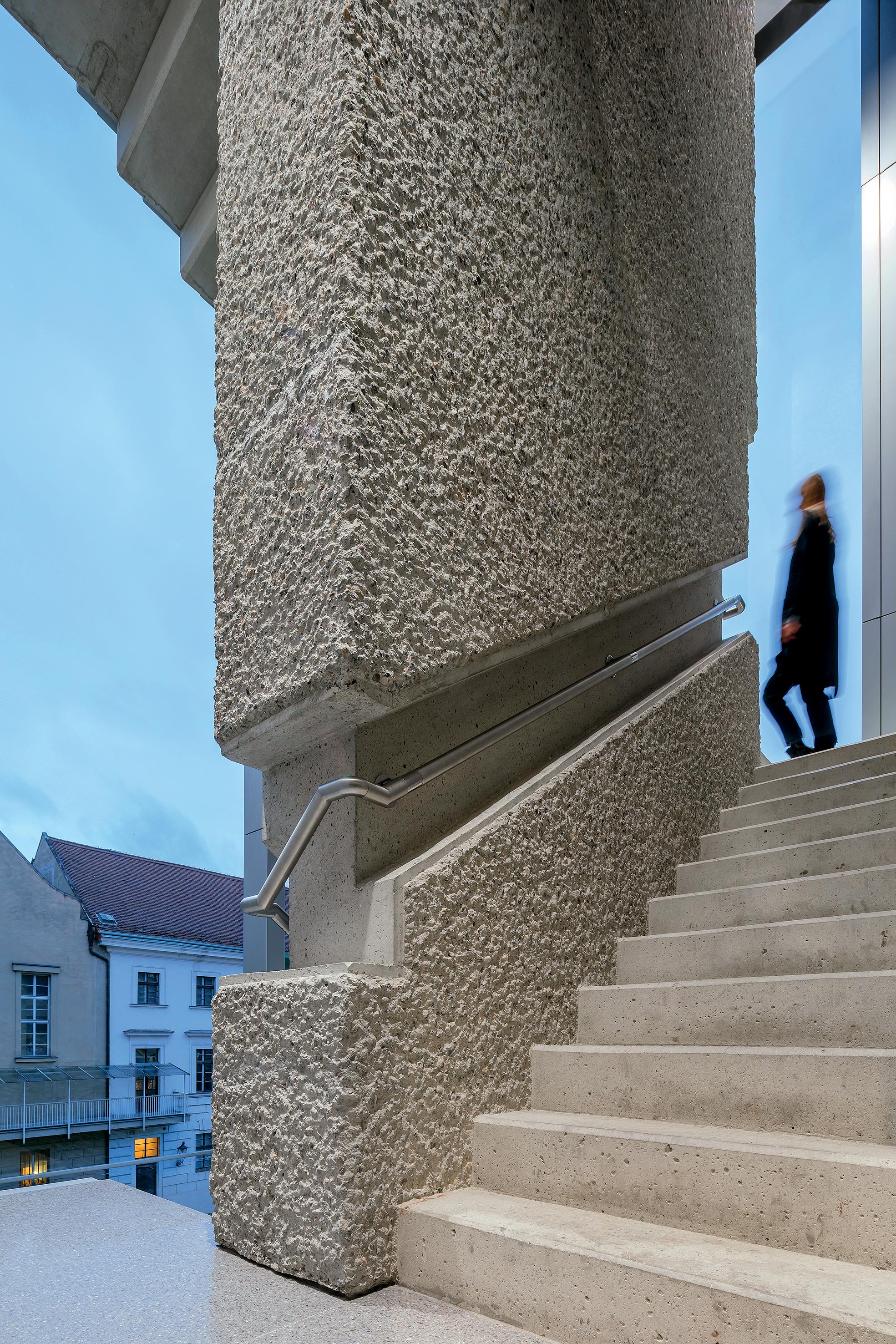
You have to be really respectful when doing something like this, even in the most minute details. To preserve the spirit of the place while also meeting the requirements at hand. There was a classicist wooden truss, for instance, that needed to be painted with fire retardant coating. You can't use the regular one, so we had to look for one with glaze. We had to source sandstone, granite in ochre. The new construction we made contrasting instead. A reinforced concrete skeleton with spikes to make it uneven, contrasted against smooth duralumin, glass... And the element tying everything together are the terrazzo floors – partly in the old building, partly in the new.
Before establishing your own studio, you worked in Vienna...
I had a friend in Austria who had asked me to work with him on a project. I went there in May 1990 for a couple of weeks and it turned into four and a half years.
Was it a big learning opportunity?
A big shock primarily. We had no materials here at the time and I was astonished at just what you could get your hands on over there. But also in terms of methods and thinking. We then got to work in Boris Podrecca's studio, and that was a big learning opportunity. And the things they were working on! Like the Ca' Pesaro palace on Venice's Canale Grande, which was being redesigned as a museum of modern art... Then I was approached by Živnostenská Banka – they said they had an old neo-renaissance palace in Liberec, and asked me to work on it. So, I was going back and forth between Vienna and Liberec for a while. Then I realized that I got to the project manager level in Vienna and I'm not likely to go any higher. There also came family reasons, so I decided to come home.
Were you certain that your studio would work? Did you have any kind of buffer?
Not really. I was young and didn't pay much heed to potential risk, I just didn't think anything would happen. But we finished the Liberec project and suddenly there was a vacuum, we had nothing. At that time, I might have even paid someone to give me some work. [laughs]
When did that change?
I like to say that life is about chance, about being in the right place at the right time. A friend of mine who is a sculptor called me and said that his client just bought a 1928 villa in Podolí. He organized a tender of his own, called in three architects, and ended up picking us. That was a stepping stone and from there things went smoothly. We finished it in the year 2000 and four years later – in the meantime, we did some interior design, refurbishments, nothing major – we got a call and were asked whether we'd like to participate in a tender for a skyscraper in Pankrác. And we ended up winning it.
Is the V your magnum opus, or is there another that you hold more dear?
You know, it's similar to how they say that there are no small parts in acting. Our buildings are essentially our children. And just try deciding which one of your children is your favorite! We are essentially a small, you could even say boutique, studio; we don't do hundreds of apartments for huge developers and it's not something we would enjoy either. The V is, naturally, one of the more prominent projects due to its size and importance. But that's also because when we do a beautiful villa somewhere, nobody knows about it.
You need to have an incredible imagination to come up with architectural projects, but that's not something one can learn...
We went to a Wagner concert; incredible. And I have not the slightest inkling as to how he put all of it together. Things are likely similar in this case. I'm sure he would probably have a hard time understanding how to "compose" some beautiful architecture. It may sound bad, but I guess it must be a gift from up above.
What are you currently working on?
We just finished a beautiful villa in the Baba functionalist colony in Prague and we have a few other villas and some interior work lined up. And primarily, we're working on the second stage of the Hybernská project – a monastery that is across the street from the Municipal House. Among other things, we're planning to put a roof over the courtyard, which will create a beautiful enclosed space, a kind of half-outdoor/half-indoor area. That's the biggest project right now.
CV BOX
Radan Hubička (born November 5, 1960, in Prague) is a chartered architect.
He graduated from the CTU, Faculty of Architecture. In 1989, he did an internship at the CBC Paris design studio. A year later, he started working at Tadeusz Spychala's Architectural Studio in Vienna, and then he worked in Boris Podrecca's studio between 1991 and 1995.
In 1995, he established his own Radan Hubička Architectural Studio (AARH) in Prague.
In 2005, Hubička won the architectural tender for the construction of the V Tower residential building in Prague. It earned him many awards, including a win in the International Property Awards high-rise category. Another one of his projects, the XY Na Hřebenkách residential building, was nominated for the Mies van der Rohe Award in 2007.
His refurbishment project of the historical building in Prague's Hybernská street has also received numerous accolades and many of his designs for residential villas have been celebrated for being perfectly set into the surrounding landscape.
He is the son of Stanislav Hubička who was the chief architect of the Nusle Bridge.
His daughter Johana and son Robert are also architects. As is his brother Radim, whose son Richard is just finishing secondary construction school.
_SYNER_as_2.jpg)
Detail of the refurbished building in Prague's Hybernská street.
reklama


