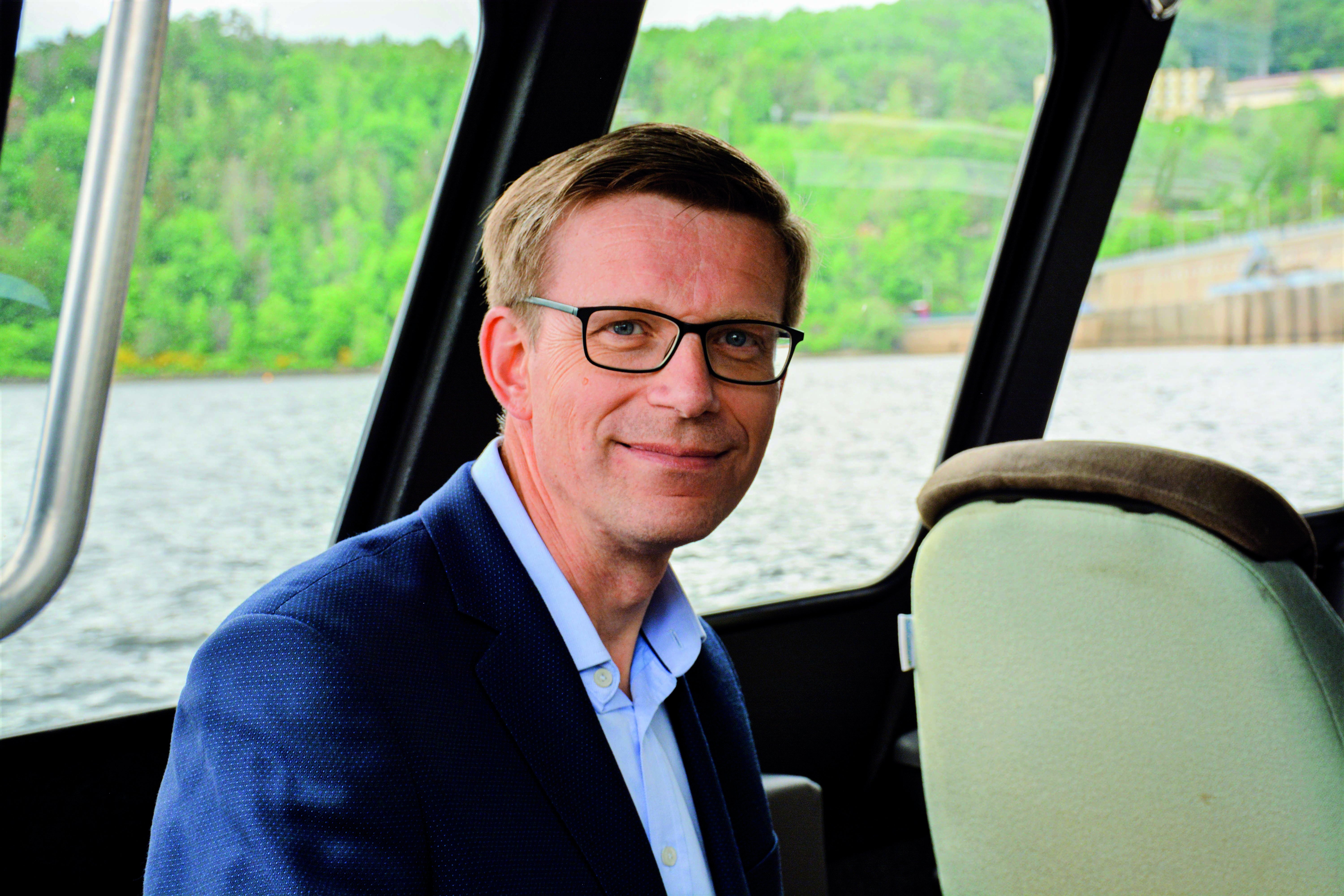
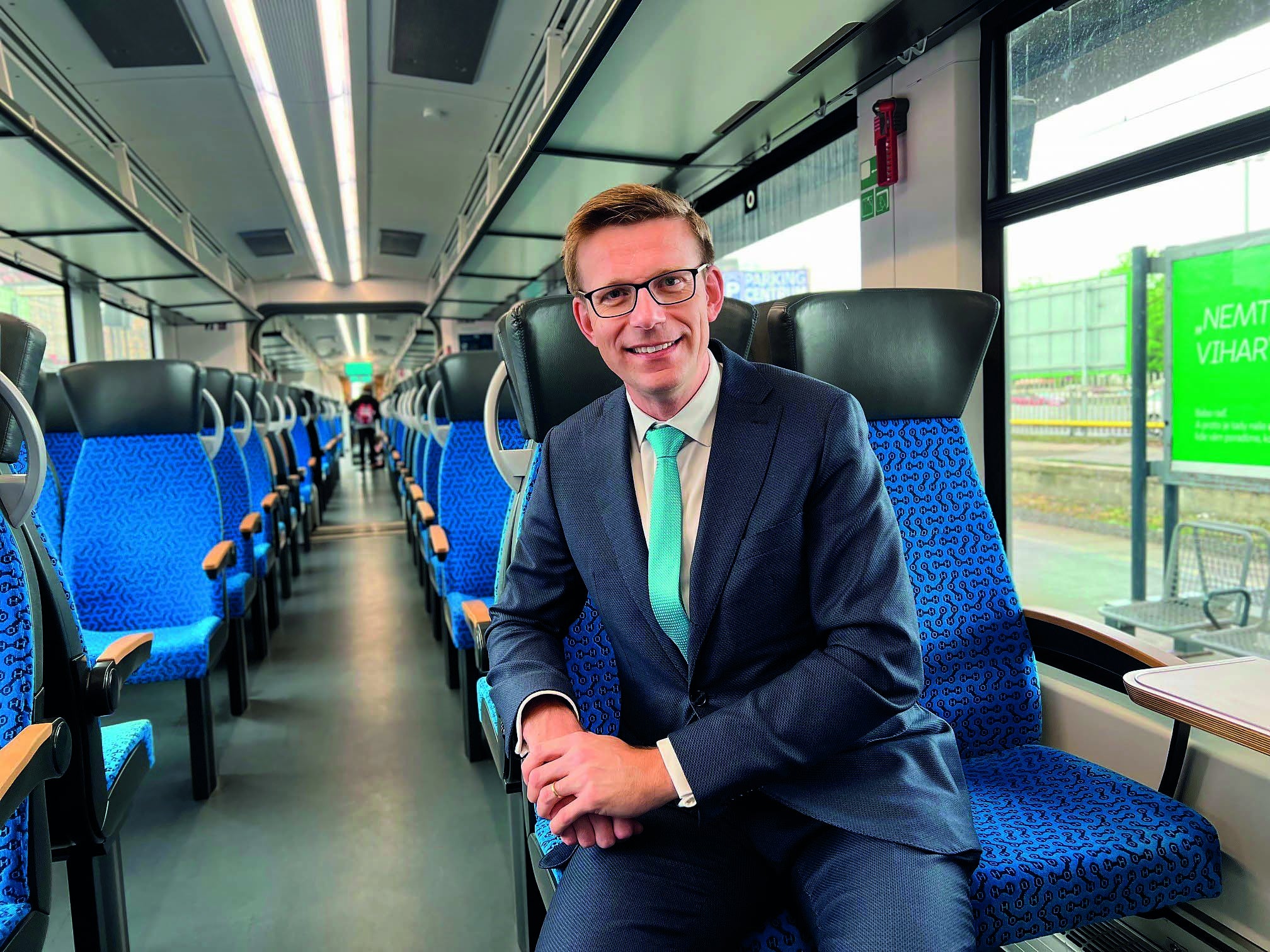
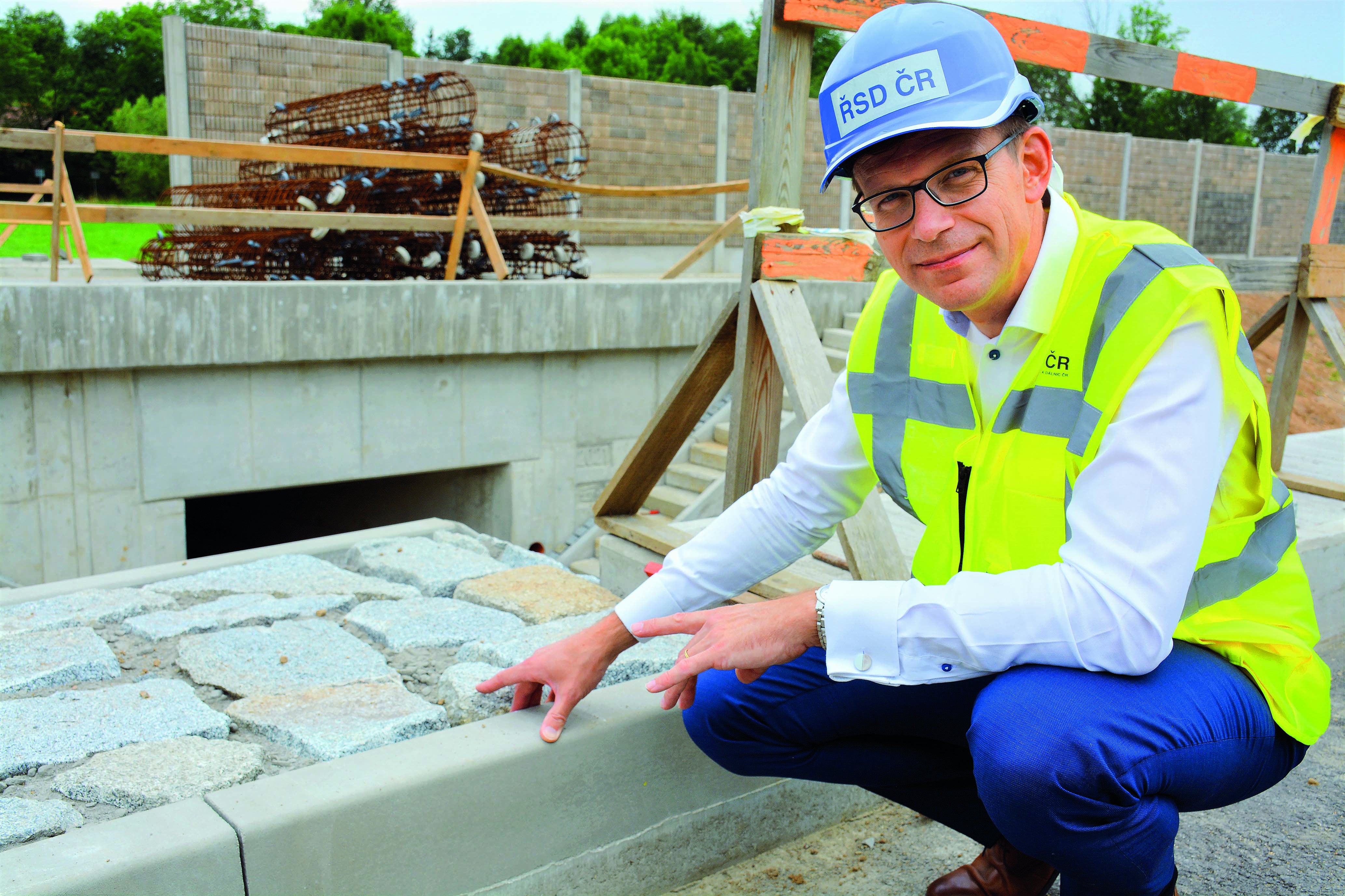
Pretty much everyone either takes the train or bus or drives their own car. And when something isn't working properly, they like to complain about the railroad or highway administration or even the minister of transportation. That's who Martin Kupka is. He's in charge of a very hectic department but when he talks about it, he's calm, factual, and knowledgeable without having to dig up numbers. All the data is in his head.
On one hand, the importance of rail freight transport is often discussed, but on the other, also the issue that there is no way to increase its volume. What's the solution?
Current capacities truly are at their limits. There is only one way forward for Czechia: build new high-speed railroads that could service a portion of long-distance passenger transport and free up the capacity of current corridors for the transport of regional passengers and freight. Another task that the Railroad Administration is currently working on at full speed is the removal of bottlenecks, especially in large cities. The major junction in Pardubice is going through an extensive reconstruction, which is likely to be finished next year. Another important matter is the electrification and increased capacity of the Velký Osek – Hradec Králové – Choceň track. The primary corridor between Prague, Česká Třebová, and Olomouc is extremely overloaded, so this specific connection would create an important bypass that would allow trains to avoid affected areas and help prevent an all-out traffic breakdown in case something goes wrong. In parallel to the tracks, we also need to build new terminals that will facilitate transloading from trains to trucks, especially in the so-called last mile. We could learn from Switzerland in this regard. Railroads should be the primary mode of transport for distances in excess of 700 to 800 kilometers, not only due to efficiency but also the lower impact on the environment.
You have been a minister since 2021, so it's a little early to recap your term. Still, what positive things have happened during your time in office?
The modernization of the fourth railroad corridor towards Tábor was finalized. Following a demanding refurbishment project, this June we will reopen the very difficult section between Brandýs nad Orlicí and Ústí nad Orlicí, which is a part of the main railroad corridor. This would mean that trains between Prague, Česká Třebová, and Brno will be much faster and more reliable, which will in turn bolster traffic from Prague to Vienna, Ostrava, and Slovakia. We are bound to finalize the Pardubice railroad junction rebuild, and I also consider the refurbishment of the historical Main Train Station building in Prague a success. Another positive thing would be if we managed to move the high-speed railroads along to a point where, by the end of my term, we would have the first official decrees in hand and we could start the construction work. In terms of highways, we are set to open more than 100 km of new sections next year and we would like to expand the highway network by an additional 200 km by the end of 2025.
I've heard talk of compensation for the towns close to which the tracks will run...
It's essential that the construction of the high-speed railroad also brings positive changes to the municipalities. There needs to be a service road constructed next to the high-speed track. In some cases, it could help solve traffic issues in the area if it is classified as a class II or III road. It would help us deal with the issue of Kounice, Český Brod, and other municipalities in Central Bohemia which the high-speed track is going to bisect, but where they are also dealing with a long-term issue of transit traffic. Upgrading the planned service road to a class II or III road doesn't mean that much of an additional investment. And it would be a major help in solving the traffic problems in the area. In other places, we could help solve their issues with bicycle traffic or local roads.
Czechia, similar to other EU countries, has pledged to switch three-quarters of its transport from trucks to railroads by 2050. Is that realistic?
The discussions have shifted to a more realistic half, rather than three-quarters. The truth is that road transport is much more dominant than rail, although, certain commodities are difficult to transport on roads, and that's where rail wins out instead. Such commodities are mainly loose resources and ores, but also steelworking products and, naturally, large volumes of diesel, which constitute one of Czechia's primary needs. Last year, we managed to negotiate a major decrease in the refurbishment timeline of the track between Bad Schandau and Hřensko with the Sachsen region and Deutsche Bahn Netze. Transport will gradually start flowing there now instead of in two years as was initially planned. That's big news for diesel transport into Czechia, as we depend on traffic from Hamburg for half of our supply.
How long ahead do you need to plan the development in this sector?
Roughly fifty years, in ten-year increments. But Czechia was sorely missing a much more short-term outlook as well as a basic economic foundation. We now want to propose an investment plan for the next ten years. The government is trying to approach investing in transport infrastructure as an opportunity to kickstart the economy, which is a wise decision. Even this year, despite all the hurdles, we are set to invest more money in this sector than the year prior. The ten-year investment plan naturally involves not only railroads but also the finalization of the fundamental highway network. That would constitute a major boost for the economy as well as every citizen because they could simply get to where they're going much faster. The fact that our highway network is unfinished limits us in many ways. It slows down economic development as well, which is clearly visible when looking at other countries that managed to better develop their infrastructure in the past. For instance, Poland expanded its highway network by 178 percent in the last ten years, building nearly 2800 kilometers of highways. Here it was just 12 percent; we built 145 kilometers of new highways. And if we look deeper, we'll see that Poland's GDP per capita increased by 24 percent, whereas in Czechia it was only 14. These are some of the arguments I present to my colleagues in the government – that these projects allow the economy to take a deep breath and develop more quickly. If future governments also accept this outlook we have, we're certainly in for times of intense development. It's not just some sort of vision but rather a concrete framework of necessary investments. The invested amounts will be major and it will be very difficult to manage everything correctly.
WHERE WILL THE MONEY COME FROM?
Martin Kupka mentions large volumes of investments in the coming years. But where should the state look for the finances? "As opposed to previous governments, we've already prepared a wider selection of tools," he says. "We're putting together options for bond financing, PPP projects, European Investment Bank loans, and we want to make use of a loan from the National Recovery Plan as well. We're also negotiating with commercial banks about the possibility of them coming together in larger consortiums, for instance, and loaning finances to the state at reasonable interest rates. Ultimately, the final makeup always has to mean the least possible burden in the future. But the fact is that if we give up on transport infrastructure, we'll only be further stunting economic development."
CV
Martin Kupka (born October 28, 1975, in Jilemnice) is the minister of transportation and a former member of the Central Bohemian regional assembly.
He graduated in journalism and mass communication from the Faculty of Social Sciences at Charles University, later becoming a show host at Czech Radio.
In 2001, he made the transfer to public relations. He was the spokesperson for Prague City Hall, the Central Bohemian Region, and even the government (2010). He was voted spokesperson of the year on multiple occasions.
Kupka was the mayor of Líbeznice between 2010 and 2021, he became a member of the Central Bohemian regional assembly in 2016, even serving as deputy regional governor. He has been the vice chair of the ODS and an MP since October 2017. He was appointed as minister in December 2021.
He enjoys classical music, books, and hiking in nature. He is married and has two children.
reklama


