Former multiple minister (defense, European affairs, foreign affairs) Alexandr Vondra is at the end of his five-year tenure as an MEP. Whether he'll keep his post will be decided by the voters in June. Vondra's plans for another potential term in the European Parliament are crystal clear.
A big success of yours has been the approval of a significantly diminished set of Euro 7 standards by the European Parliament, which you played a major part in as the rapporteur. Is this the dawn of salvation for combustion engine cars in the European Union?
I hope so. The form in which the Euro 7 regulation was approved essentially kept the conditions for personal combustion engine cars at the level of Euro 6. We are therefore no longer facing the danger of car manufacturers discontinuing the production of such cars. We really were on the precipice of such a thing happening before because the European Commission's proposal was draconic for combustion engines. But a de facto ban on the production of such cars starting from 2035 is still in effect. We sadly lacked the necessary majority to abolish the ban with today's configuration of the European Parliament. But the configuration is set to change after the June election, and I have faith that we will come back to the topic of the ban and it will be abolished. I will definitely be involved in that. Technological development that will facilitate the efficient production of synthetic fuels goes hand in hand with it.
Was the approval process of this regulation difficult in the European Parliament as evidenced by the rather close result of the vote?
Yes, it was. It took a year of hard work. And also excellent collaboration with our Minister of Transportation Martin Kupka who formed and maintained the so-called blocking minority. Meaning eight countries who steadfastly refused to support the original proposal and forced a change to the draft. It was then up to me to form a different kind of majority in the European Parliament. I was clear upfront that I wasn't counting on the greens, socialists, and radical leftists. All of them are extremely green and they backed Timmermans's radical proposal. I brought together centrist and moderate right-wing parties as well as those that are clearly leaning right and the others don't communicate with them all that much. Their votes weren't tainted in my eyes, seeing as they led to a good thing and helped further our interests. In fact, it was the only attempt to establish a right- wing coalition in this configuration of the Parliament that worked. All I had to do was make a concession to the French who wanted to limit brake and tire emissions. In the end, it makes sense because microplastics and heavy metals are a real threat to our health.
Will the Green Deal see a slowdown in the new Parliament to match its pace with the actual capabilities of the European economy?
Nobody's likely to get rid of the Green Deal. Everyone is far too invested in it. And decarbonization is needed as well because the greenhouse effect is an issue. However, it must be implemented rationally and gradually, not ideologically and without regard for economic capabilities and social impact. It's like driving a car. We can't just have our foot on the gas; we need to brake and steer as well. Otherwise, we'll crash and burn. The financial impact of these radical measures is being felt even in the more affluent Western Europe. Farmers and entrepreneurs alike are criticizing the Green Deal. That gives me hope that the next Parliament will be more rational.
Has the European Union finally fully rehabilitated nuclear power? And how crucial is the development of nuclear energy for Central Europe?
Things have improved significantly thanks to our pushing. When I came to the EP five years ago and asked for nuclear to be recognized as a clean energy source in the so-called green finance taxonomy, they looked at me as if I'd gone mad. “Sasha, nuclear is not a word to be spoken here!” they would say. I didn't give up and kept pushing. We prepared a resolution of the Czech Parliament, which essentially threatened that we would pull out of the Paris Agreement if nuclear wasn't recognized as a clean energy source, and sent it to the European Commission. Our argument was clear: the potential of wind and solar energy in Central Europe is limited; decarbonization won't work without nuclear. Then I established a group of MEPs supporting nuclear power with the French. We've achieved a lot in three years. Nuclear is recognized not only in the taxonomy but also in the legislation on renewables and clean technologies as well as in the new electricity market rules. In practice, this means that anyone planning to build new nuclear sources will have access to loans, insurance, and financing.

What's another “notch” of yours in European politics in the last nearly five years you have spent in the European Parliament?
Besides cars and nuclear, I was very active in another area of the Green Deal. It concerns the protection and restoration of nature. This is an area where I was on the other side – trying to protect the good things in the Commission's proposal as I am of the opinion that adapting to actual changes in climate is more important right now. Mitigation, meaning the fight against climate change, is a global issue. Simply put, we could bend over backwards lowering carbon emissions here in Europe, but it won't bear any fruit if China, India, Russia, the USA, or Brazil keep chugging away, releasing it into the atmosphere. We'd be asking our people to make sacrifices without any prospects of a deliverance in the form of a “cooling” for another hundred years. On the other hand, adapting has a local effect. A more diverse landscape, water retention, protection of soil, forests, grasses and biodiversity can all help us actually adapt to climate change, and in a matter of years at that. However, EU proposals in this area have – partly due to needlessly radical views of the greens – culminated in farmer protests; the politicians got scared before the election, and the ruling on the proposal was postponed until after the election.
You are going into the election as the leader of a joint SPOLU coalition governmental ticket. Are you confident that you can win the European election in the Czech Republic at its helm?
Absolutely. It's the main reason why we're going at it SPOLU (Translator's note: the coalition's name means “together”) in this election as well despite our parties having slight differences in various policies. But we know how to reach consensus and that's what you need in Europe.
Do you think that your Conservatives and Reformists group in the European Parliament might start aligning more with the European People's Party? Perhaps to such an extent that they might once again become one in, say, ten years?
The European Conservatives and Reformists (ECR) group was founded jointly by us, the ODS, and the British Conservative Party. It was established for two reasons. First, to help British PM Cameron keep Britain in the EU. And second, the European People's Party (EPP) at the time was exclusively under German and French control. Pushing anything through there was extremely difficult. I will admit that things have changed a little bit since then. Britain has left the EU. The French numbers in the EPP have dwindled to marginal levels; the French scene is dominated by the Macronists (the centrist Renew group) and Le Penists (the ID group). On the other side, the Polish have been a breath of life in the ECR as has just recently been PM Meloni's Italian party. So there's no reason to disband or integrate. But we will definitely want to work more closely with the EPP after the election. I hope that my center-to-right Euro 7 coalition could become a framework for EP operations following the election.
How do you feel about the developments in the Ukrainian war as a former defense minister? Are you growing concerned about Kyiv's ability to withstand Russian aggression, or are you turning optimistic about a possible Russian defeat?
I am naturally concerned. Russia is attacking, Ukraine is defending itself. It's a battle of David versus Goliath. Ukraine just cannot do without the help of the West, which means us as well. Leaving Ukraine at Russia's mercy would ultimately lead to its defeat. That wouldn't satiate Russia's appetite for aggression, it would amplify it. I understand that people are tired of the two years of war and I understand that they want peace. I want the same thing. But it must be true peace, not a route to Ukrainian capitulation. It could be some form of compromise, but it must be accepted not only by Russia but also by Ukraine. And for Ukraine to get its people to accept this peace, it needs safety guarantees from the West that will deter Russia from any future aggression. We as Czechia cannot provide such guarantees ourselves, so we should refrain from giving unsolicited patronizing advice on how such a peace should look. But at the same time, it is our duty to be in concert with the West in aiding Ukraine. Otherwise, we could end up being the next step in the plans of the aggressors. And I can't believe anybody would want that.

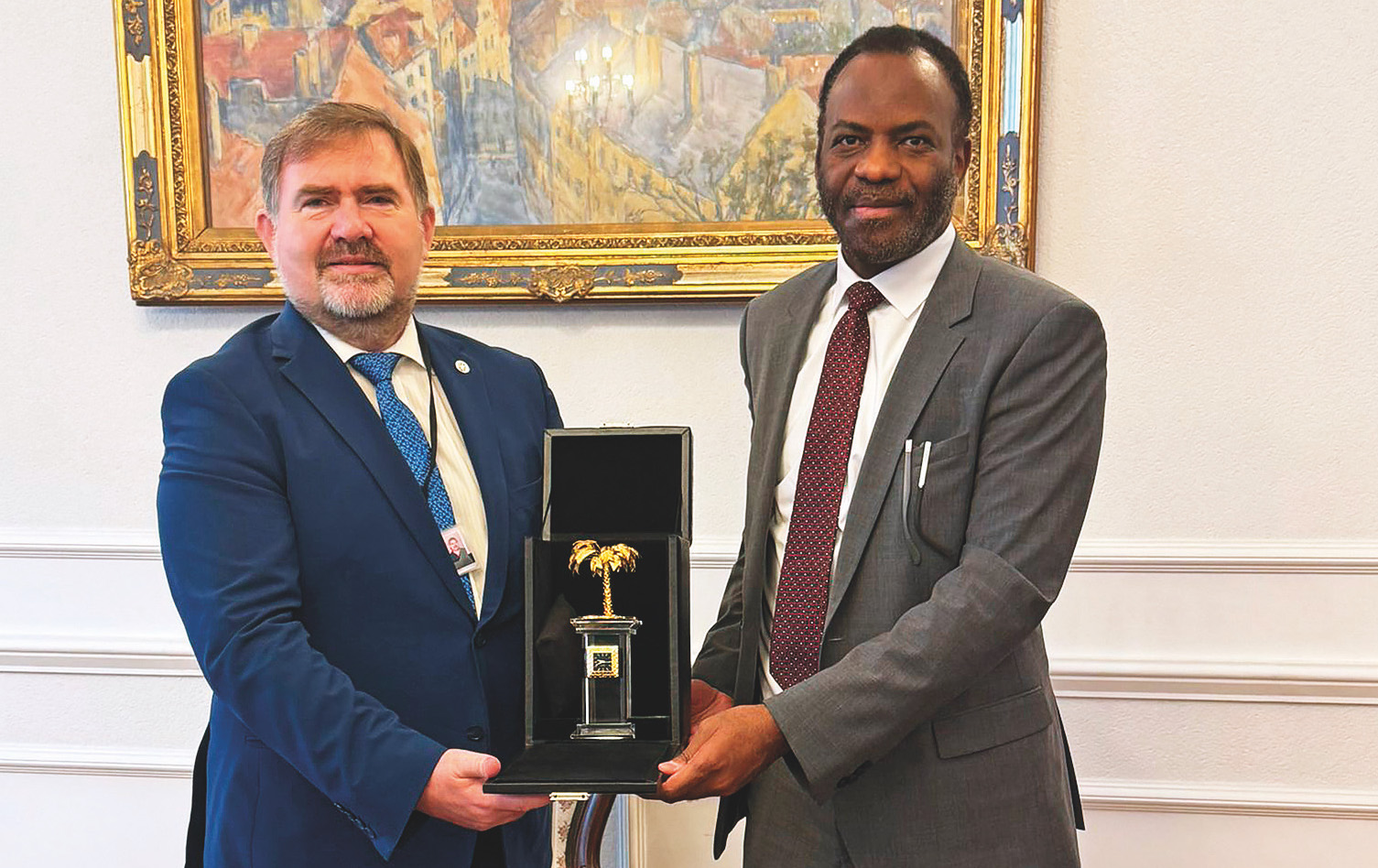
With fellow MEP, Jan Zahradil
NATO AND THE EU
It will be twenty years since Czechia's accession to the European Union and the country has also recently celebrated the twenty-fifth anniversary of joining NATO. Which of these anniversaries is more crucial for Alexandr Vondra personally? “Both institutions are crucial, both of them help us plant our feet firmly in the West,” he says. “NATO when it comes to defense and security, the EU primarily in terms of economic matters. But there is, in fact, one difference. We joined the NATO earlier. It helped pierce the veil of uncertainty in relations with Central and Eastern Europe. Whether the EU would have expanded so soon and so smoothly had the USA not made its strategic decision to expand NATO is a big unknown.”
CV BOX
Alexandr Vondra (born August 17, 1961, in Prague) is an MEP and vice-chair of the ODS.
He teaches international relations and security at UJEP in Ústí nad Labem and at CEVRO Institute in Prague. He is also the director of the Center of Transatlantic Relations Council at CEVRO Institute, honorary president of the Czech Euroatlantic Council, and member of the Czech-German Discussion Forum.
He graduated in geography and earned a Doctor of Natural Sciences degree. He later worked as a curator of the Asian collections at the Náprstek Museum.
In 1989, he became the spokesperson of Charter 77 and a co-author of the “A Few Sentences” petition. He was imprisoned for his actions. In November 1989, he was one of the founding members of the Citizen's Forum.
In the years 1990-1992, he worked as an advisor to President Václav Havel. He then spent 5 years as the first deputy minister of foreign affairs and later worked for four years as an ambassador to the USA, starting in 1997.
In 2006, he became minister of foreign affairs for a year. He also spent six years as a senator and two years as minister of defense. He has been an MEP since June 2019.
Vondra is married. He and his wife Martina have three children – Vojtěch (31), Anna (29), and Marie (26).
reklama