_2.jpg?h=709&w=1100&fit=crop)
Alexander Dubček being elected first secretary of the Central Committee of the Czechoslovak Communist Party in January 1968 gave people hope in the revitalization of society and a better life based on democratic principles.
The attempt to install “socialism with a human face” was cut short on the night of August 20, 1968, by a military intervention of the Warsaw Pact armies with the aim of neutralizing the looming “counter-revolution” and the risk of the Czechoslovak Socialist Republic (ČSSR) seceding from the Socialist bloc. Dubček himself disappeared from politics for nearly 20 years despite being sympathetic to the activities of Charter 77. He only resurfaced in the political landscape following the Velvet Revolution and the fall of the communist regime in 1989.
Initiating a process of hope
Alexander Dubček embraced the values of European integration and believed in human kindness. He became the symbol of the reformation process, democratization as well as democracy, unfulfilled hopes, and interrupted reforms. Dubček believed that a good communist should espouse democratic values, which initiated a process that reflected positively in society. People saw an opportunity for the gradual implementation of fundamental rights and freedoms as well as the abolition of censorship, and the Slovaks were also keen on the idea of renewed Slovak statehood within the federal framework of the ČSSR.
Turning point
Spurred on by several members of the Czechoslovak Academy of Sciences, a manifesto labeled Two Thousand Words was published, wherein the publicist Ludvík Vaculík criticized conservatism within the Communist Party of Czechoslovakia (KSČ) and called for an increased pace of the democratization process. USSR communist party leaders saw the manifesto as a direct call for counter-revolution. The developments in the ČSSR made other communist party leaders of the Soviet bloc uneasy as well. They expressed their fears that the ČSSR would secede from the Soviet bloc in the so-called Warsaw Letter. The Central Committee denied this unequivocally, however. At behind-closed-doors meetings between the Politburo led by Brezhnev and the Central Committee delegation headed by Dubček, the Soviet side requested that the budding reforms be terminated and the Club of Political Prisoners (labeled K 231) and Club of Committed Non-Party Members (KAN) be dissolved. The KSČ declared its intentions to stop “anti-socialist tendencies” by democratic methods, which was further ratified at the meeting of Eastern bloc communist party leaders in early August 1968 in Bratislava.
Removed by force
The Czechoslovak reformation process was stifled by the arrival of interventionist armies of the Warsaw Pact on August 21, 1968. In the early hours of the morning, Alexander Dubček and other party representatives were detained and deported to Moscow, where, following days-long negotiations with Soviet leaders, he was forced to sign the Moscow Protocol outlining the so-called normalization of conditions in the ČSSR. The protocol mandated the presence of Soviet armies in the ČSSR until such a time that the “danger to socialism” has subsided. In practice, this meant a forceful end to all newly rising hopes and the onset of normalization policy. On the first anniversary of the invasion, a wave of protest rose up only to be quickly stifled, and the so-called Baton Act was subsequently passed, which allowed for much more severe punishment of dissent against the communist regime. In reality, it was all part of a ploy of Husák’s party leadership intended to stamp out reformist forces and pacify the public.
Victim of the “invitation letter”
Dubček was gradually removed from all of his party functions due to his disagreement with the occupation policy. At a Central Committee meeting on April 17, 1969, he resigned as first secretary of the Committee. Shortly thereafter, he held the post of ČSSR ambassador to Turkey for roughly six months, where he was under surveillance of the Bulgarian secret service at the orders of the Czechoslovak intelligence agency. Many expected him to leverage his time at the embassy to emigrate, but he never did. Dubček himself later labeled his diplomatic mission to Ankara as forced exile and compared it to the deportation of Leon Trotsky.
Under surveillance
In 1970, Dubček was expelled from the KSČ. The assemblage of politicians headed by Gustáv Husák subsequently came into power, which resulted in blind allegiance to the USSR, reinstatement of censorship, and dogged persecution of those involved in the reformation process. Alexander Dubček was one of the main opponents of the regime despite being forced to live in isolation throughout the entirety of the normalization period. Although he never took part in dissident activities, he repeatedly spoke out against normalization and defended the 1968 reforms. The fruit of his labor was constant surveillance by the secret service and persecution.
Back in the limelight
After the communist regime toppled in November 1989, Alexander Dubček rejoined political life. In December 1989, he was elected chairman of the Federal Assembly of the ČSSR, or rather the ČSFR, and became chairman of the Social Democratic Party of Slovakia (SDSS) in the spring of 1992. Dubček received numerous awards, international distinctions, and honorary degrees for his extraordinary efforts in furthering democracy and defending human rights.
Beloved by the nation
People who knew Dubček all agree that, irrespective of the position he might have held in the state apparatus of the independent Slovak Republic, he would have been able to use his natural authority to prevent the numerous missteps and excesses that happened as the new state was being formed. Alexander Dubček believed in a state union between Czechia and Slovakia. He feared its dissolution as he considered the common state to be the best way to safeguard the interests of both nations. His death in 1992 was a loss not only for Slovakia and the nation that loved him but for all of Europe and the world, which respected him as a politician.
Still garnering interest
In the 2019 RTVS Biggest Slovak poll he came in sixth place. But there have also been critical opinions of Dubček to offset the commendatory ones. Certain Slovak historians point out Dubček’s inability to clearly formulate his stance and vision. They also dispute his contribution to democracy and the fall of communism, hoping to provide the public with a different point of view on historical events beyond just those of 1968. Alexander Dubček himself provided a timeless answer: “My sin was, and remains to be, the fact that I wanted to tread a different path. That is why I’m being slandered and besmirched. However, our nation knows best who in our land holds solid opinions… You can never hide the truth forever… I feel that the East and the West need to find a way to meet in the middle. It is in the interest of all of humanity.”
CV BOX
Alexander Dubček (born November 27, 1921, in Uhrovec) spent his childhood and early youth in the USSR where his parents moved as part of Interhelpo. He returned to Slovakia in 1938.
In 1944, he took part in the Slovak National Uprising. Following WWII, he held various political functions. He earned a PhD in political sociology from the University of Politics.
In early 1968, he replaced then-President Antonín Novotný as first secretary of the KSČ Central Committee, holding the position until April 1969 when he was removed from all party functions.
Following a short period at the embassy in Ankara, he spent the rest of his time until retirement as either a clerk or a construction worker, living under constant surveillance of the State Security (StB).
Dubček resurfaced in the political landscape in the autumn of 1989. He was a potential presidential candidate but decided to step down in favor of Václav Havel, becoming speaker of the Parliament instead.
Following the breakup of the federation, he would have likely become the first president of the independent Slovak Republic, but he never lived to see its inception. Alexander Dubček died following a car crash on November 7, 1992, in Prague.
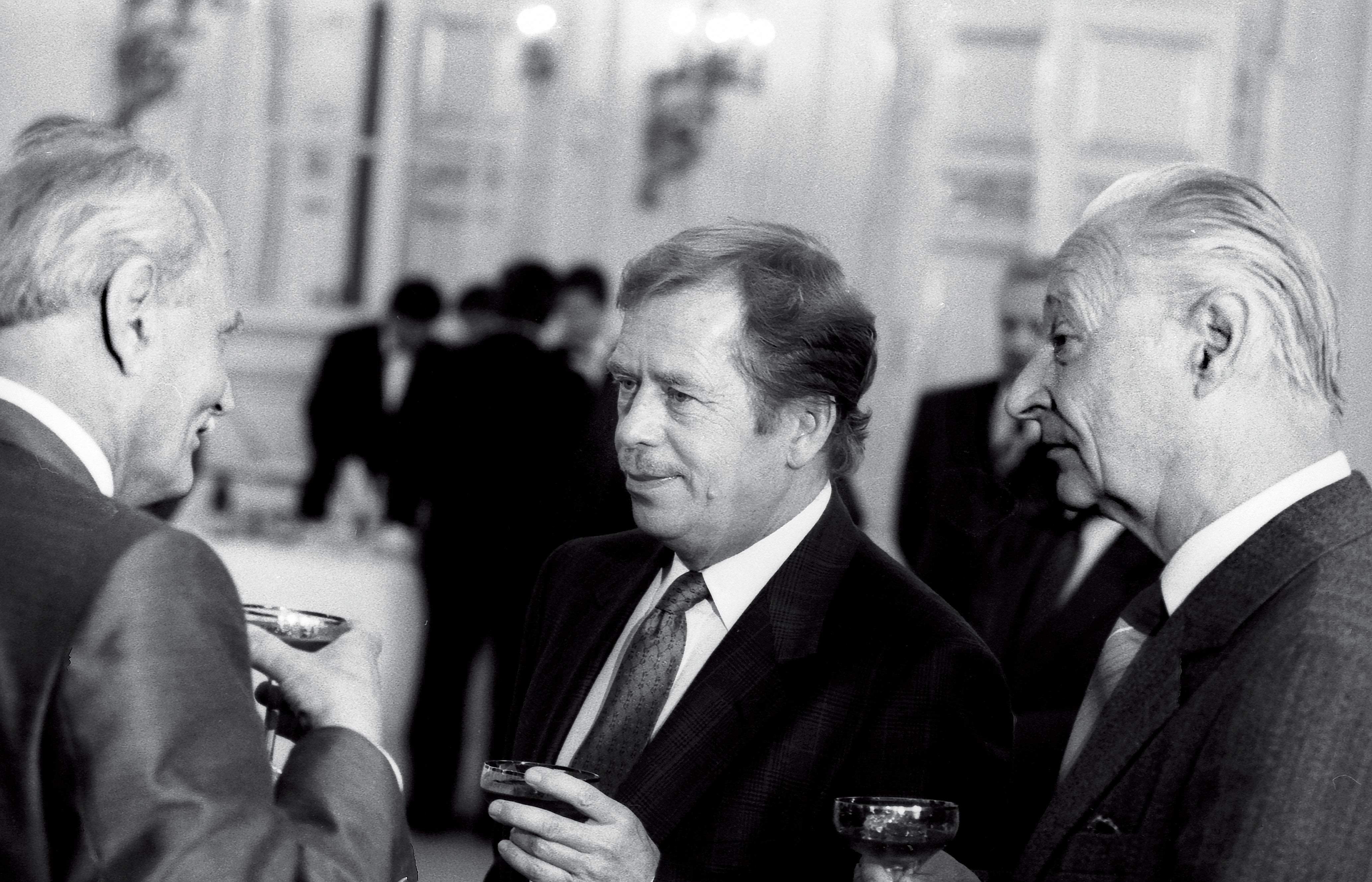
Alexander Dubček with Václav Havel and Arpád Göncz in July 1990, Prague
reklama



