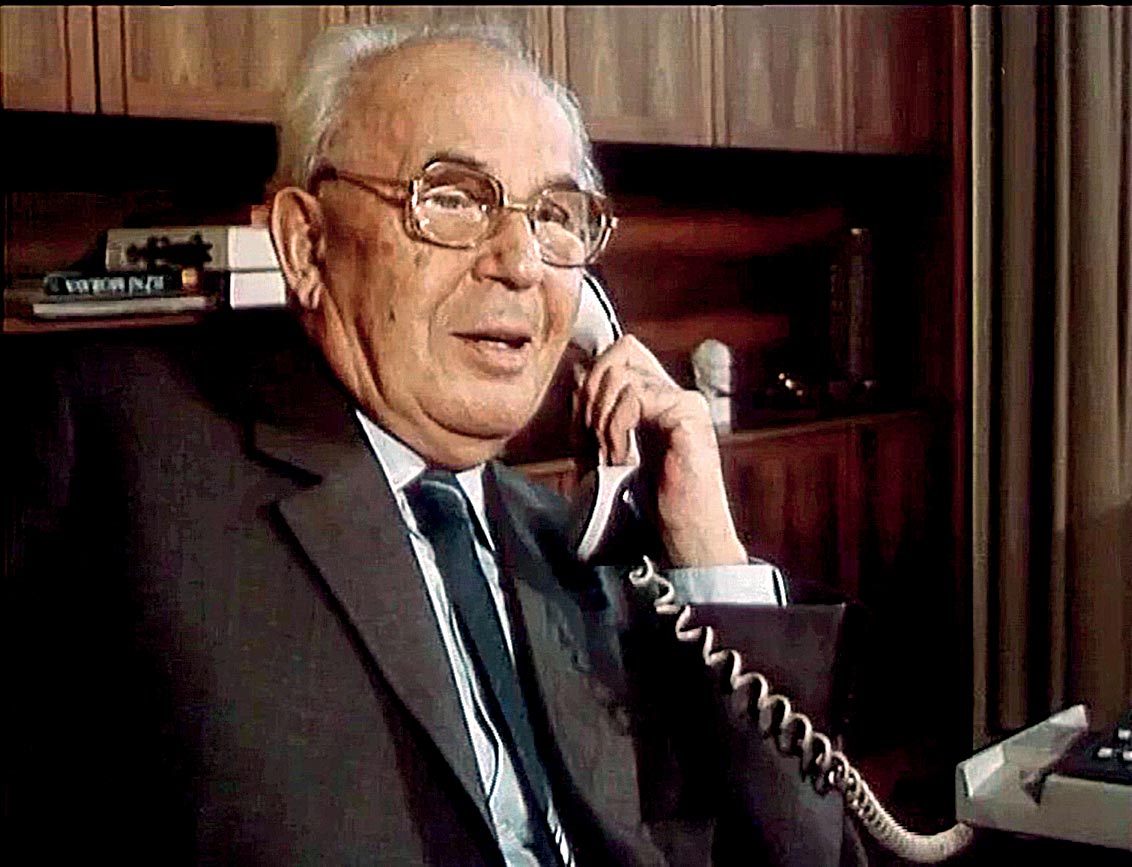
Gustáv Husák is a dramatic character in Slovak politics and beyond. The drama of his life is based on his tenacity, stubbornness, resilience, realpolitik vision and determination, intellect.
Husák was born on January 10, 1913, in Dúbravka – now a part of Bratislava. He attended primary school in Dúbravka, and the local catholic pastor convinced his father to send Augustín (so named at the time) to study further, which led to him earning a law degree with honors from the Comenius University in Bratislava and later working as a trainee at Vladimír Clementis's law firm. In September 1938, Husák married Magda Lokvencová – the daughter of a Czech bank official living in Slovakia, actress, and later a famous theater director. While studying at university, he first joined the Communist Youth Union, then the KSČ (communist party) in 1933. After the war against the USSR broke out, Husák was imprisoned. It was at that time that Magda Lokvencová-Husáková visited the father of the author of this text to plead for his intervention. Pavol Čarnogurský, being a People's Party MP, met with Minister of Interior Šaňo Mach, whom he was on friendly terms with, and asked the Minister why he was making the harmless Husák into a martyr and increasing his importance. Šaňo Mach saw his point and released Husák. After the war, Husák, from the position of commissioner of interior, intervened and ordered Pavol Čarnogurský to be released from custody as a former MP.
Wartime
Between 1940 and 1943, Husák kept to the background in the illegal communist party. In 1943, it was as if he had woken up and started climbing the party ladder. In December 1943, Husák signed a deal with former Agrarians (Translator's note: Republican Party of Farmers and Peasants), which was dubbed the Christmas Treaty by the media. In August 1944, the Treaty culminated in the Slovak National Uprising. Before the Uprising took place, in the summer of 1944, the situation in Slovakia was becoming quite dire. It was at that time that Husák's letter to Moscow was penned, wherein he suggested the accession of Slovakia as a union republic to the USSR, at least as a possible option. At the final negotiations in Moscow in March 1945, Stalin himself opposed the possibility of Slovakia joining the USSR, but it served its purpose at least in the form of leverage against Beneš. During the Uprising, Husák was sent to Podbrezová to attend a union gathering. He prepared a speech, which spoke of the post-war restoration of Czechoslovakia in line with the official narrative. The atmosphere during his speech was such, however, that he decided to omit this part altogether. In line with the Christmas Treaty, Husák was the commissioner of interior during the Uprising in Banská Bystrica. After the Germans were pushed back, he went to Moscow to attend the final negotiations with President Beneš who flew in from London. The Slovak delegation argued for a Czechoslovak federation but all it achieved was the independence of the Slovak nation and an “equal” order within the restored republic of Czechs and Slovaks. One historian wrote that this would last “until the next crisis”.

Downfall of the Democratic Party
Early after the war, only “rebel” parties were allowed to exist in Slovakia – the communist and the Democratic. The People's Republican Party project was born at the time, modeled after the French Mouvement républicain populaire, which was allied in a coalition with the French communist party. The project failed due to the demand of the National Front in Prague that Vavro Šrobár, who was politically disgraced in Slovakia, be the party's leader. What followed was the April Treaty between Slovak Catholics and evangelicals. The Treaty stipulated that the Catholics would vote for the Democratic Party in the upcoming election. The Party went on to win by a landslide in the May 1946 election. In September 1947, the communist- controlled police arrested numerous Democratic Party politicians in Slovakia under the false pretext of seditious intent against the republic, which led to the Party ceasing to exist as an effective political force.
Jailed
The communists no longer needed Husák after February 1948. In February 1951, he was arrested and charged with bourgeois nationalism to a criminal degree. He was pardoned and released from prison in May 1960. Formerly, it was Vladimír Clementis who was the “head” of the conspiratorial group until November 1951. But Moscow cared little about Slovak bourgeois nationalism against Prague. The whole Eastern Bloc country's bourgeois nationalism against Moscow was the issue. In November 1951, Secretary General of the Communist Party Rudolf Slánský was arrested and named the figurehead of the group (and later sentenced to death and executed). Gustáv Husák managed to get himself excluded from the main group headed by Slánský. Despite being brutally interrogated, he admitted to nothing. All he got was a life sentence. When serving his time, he found himself surrounded by those who were jailed when he was flying high. They blamed Husák for their incarceration and they let him know. With fists. František Mikloško and I visited Otto Obuch a few times during the 1980s. He did time with Husák and was physically strong. He defended Husák when his fellow prisoners wanted to beat him up.
Back to politics
After being released, Husák initially worked in a construction company in Bratislava; after his criminal rehabilitation in 1963, he was hired by the Institute of History of the Slovak Academy of Sciences, which is where he wrote the book “Slovak National Uprising Testimonial”. Gustáv Husák was “zoon politikon” and criminal rehabilitation was not enough for him. He repeatedly sent appeals for political rehabilitation to various party bodies. The appeals were copied and circulated around Bratislava and other cities as samizdat. In January 1968, Husák was invited to a key meeting of the Central Committee of the communist party. Despite not being a member, he gave a speech that the media at the time felt was the nail in the coffin of Antonín Novotný. In April 1968, Husák became the prime minister of the Czechoslovak government. The federalization of the republic was a key matter for him. The Federation Act was signed at Bratislava Castle on August 30, 1968. It remained – until January 1, 1992 – as the only, albeit abridged, result of the momentous year 1968.
Secretary general and president
The country was occupied by Warsaw Pact armies in August. A delegation headed by President Ludvík Svoboda flew to Moscow for the negotiations – Gustáv Husák was also a member. This is where Husák's realpolitik kicked into high gear. News would later leak that it was Husák who took a rational and genuine stance during the negotiations in Moscow. There were half a million foreign soldiers and thousands of tanks in the country and none of the state leaders had any idea what to do next. Husák's speeches after the occupation were difficult to listen to. We had no idea that the situation could be so grim. His speeches relayed that to us. In April 1969, he became the party's secretary general and later also took the office of the president in 1975. His time in power has become known as the normalization period. In December 1987, he was succeeded by Miloš Jakeš as the head of the party. It was nothing positive for the communist party, however. Husák remained the president until December 10, 1989, when he resigned as per the deal between the opposition and the communists. His last political act was to see the new government sworn in. Gustáv Husák died on November 18, 1991. As the chairman of the Board of Commissioners, he was officially my predecessor (I was the Slovak prime minister at the time of his funeral), he was a political prisoner for 10 years, he was a part of the history of a country and a continent, a constituent part of the drama of the last century.

The so-called Government of National Understanding on December 10, 1989, left to right Vladimír Dlouhý, Oldřich Burský, Ján Čarnogurský, Jiří Dienstbier, Valtr Komárek, František Reichel, Gustáv Husák, Marián Čalfa, Ladislav Vodrážka, Václav Klaus, František Pinc, Petr Miller, Róbert Martinko, Richard Sacher.
THE AUTHOR
Ján Čarnogurský (born January 1, 1944, in Bratislava) is a former Czechoslovak and Slovak politician.
He graduated in law from Charles University Prague and got his PhD in 1971 from Comenius University Bratislava.
He worked as an attorney, representing a number of religious activists and political dissidents, which got him disbarred in 1981. In August 1989, he was arrested and charged with sedition.
After the Velvet Revolution, he was the first deputy prime minister of the federal government. Čarnogurský then went on to become the first deputy prime minister of the CSFR
and first deputy prime minister of the SR, he founded the Christian- Democratic Movement (KDH) and became its chairman.
Between 1998 and 2002, he was the Slovak minister of justice, and briefly also the prime minister.
In the year 2000, he left his position as chairman of the KDH and started his own law firm. Three years later, he helped found the Paneuropean University (formerly the University of Law Bratislava).
He is very open about his Russophilia and is the chairman of the Slovak-Russian Society, established in 2006. He ran for president in 2014 but didn't make it into the 2nd round.
He has four children with his wife Marta.
reklama